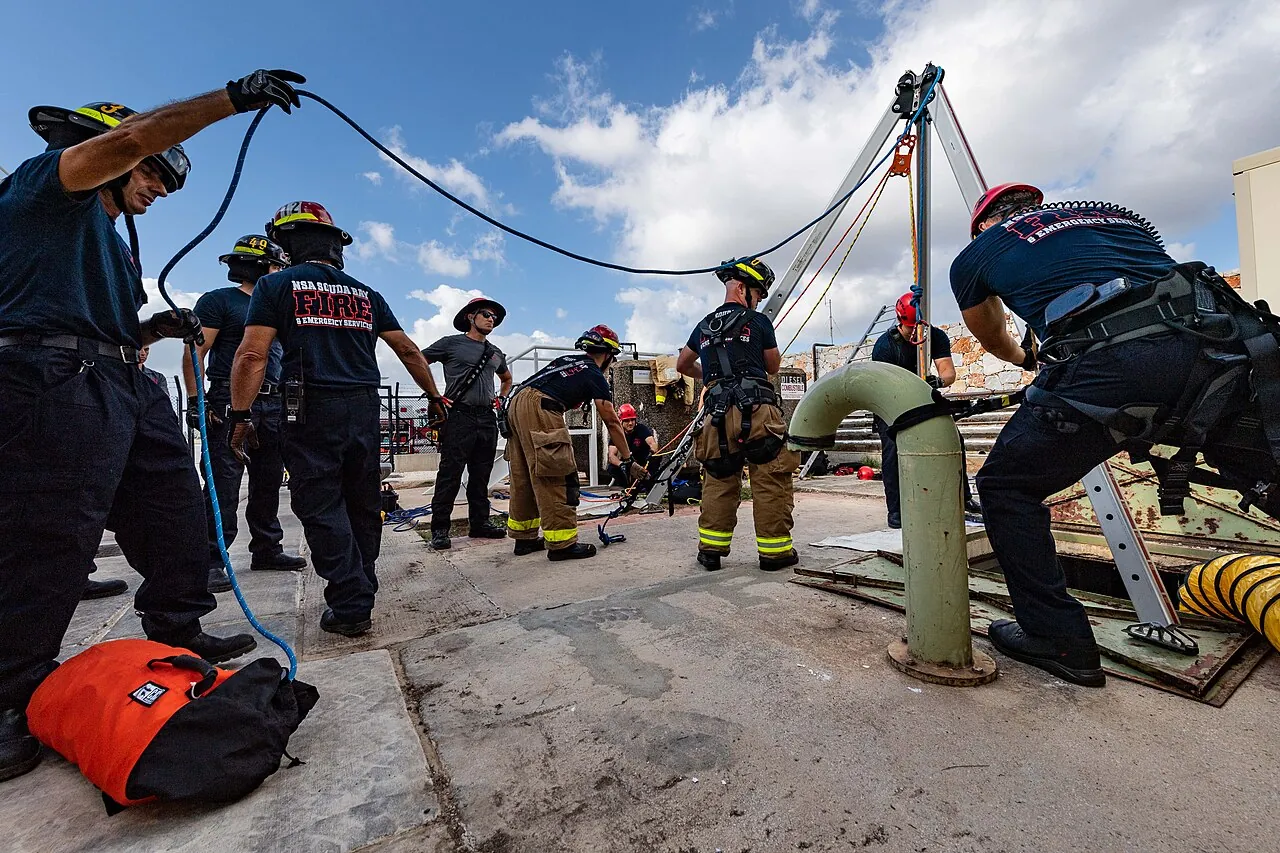

Tanks, vessels, sewers, wells, silos and pits kill workers every year, and too often the would-be rescuers who follow them in. Almost every one of these deaths could have been prevented by a few well-known steps carried out in the right order. This article walks through them.
1. Identify the space and avoid entry if you can
A confined space is enclosed or largely enclosed, is not designed for continuous occupancy, has restricted entry or exit, and can contain a hazardous atmosphere or other serious hazards: engulfment by liquids or bulk materials, moving parts, heat. National rules define it in slightly different words — the US standard 29 CFR 1910.146 on permit-required confined spaces, the UK Confined Spaces Regulations 1997 with the HSE code of practice L101 "Safe work in confined spaces", DGUV Regel 113-004 in Germany, the INRS guidance in France and, in Russia, the labour protection rules for work in confined and enclosed spaces approved by Ministry of Labour order No. 902n — but the idea is the same.
The first question is always: does anybody need to go in at all? Inspection by camera, cleaning with high-pressure jets from outside or remote sampling may remove the need to enter. UK regulations make this the first duty.
2. Permit to work
Where entry is necessary, it is planned and authorised in writing. A permit to work (entry permit) records the space, the task, the hazards identified, the isolations made, the results of gas tests, the protective equipment, the names of the entrants and the standby, the means of communication and the rescue arrangements. It is valid for a limited time — often one shift — and is closed when the work ends. The permit is a check that every precaution is in place, not a form to sign afterwards.
3. Isolation
The space is separated from everything that can flow, move or energise into it: process lines are disconnected or blanked with spectacle blinds or blind flanges, valves are locked closed, agitators and pumps are electrically isolated and locked out, and stored energy is released. A closed valve alone is not isolation — valves leak and can be opened by mistake.
4. Cleaning, purging and ventilation
Residues are removed, and the space is purged with water, steam or air. If an inert gas such as nitrogen was used to purge flammable vapours, it must itself be displaced by air before entry — see oxygen deficiency. Forced ventilation with fans keeps the atmosphere fresh during the work; the fan inlet must draw clean air and not exhaust fumes.
5. Atmospheric testing
Testing is done by a trained person with a bump-tested instrument, from outside the space, through a sampling hose and probe, at the top, middle and bottom — some gases are heavier than air, others lighter, and pockets form in corners and sumps. Ventilation may need to be switched off during the initial test, so that the real state of the space is seen; Russian rules require this.
The order matters:
- Oxygen — first, because catalytic flammable-gas sensors need oxygen to read correctly, and because oxygen deficiency is the most immediate threat.
- Flammable gases and vapours — in % LEL.
- Toxic gases — carbon monoxide, hydrogen sulfide and whatever else the process can produce.
This sequence is laid down in 29 CFR 1910.146 and widely followed elsewhere. Monitoring continues during the work, with a personal detector on each entrant and, where conditions can change, continuously at the opening. Details on instruments are in choosing a portable gas detector.
6. Entry and entry control
Only authorised, trained people enter, with the protective equipment named in the permit. If the atmosphere cannot be made and kept safe, entry is made with isolating breathing apparatus — see equipment. Every entry and exit is recorded so that the number of people inside, and their air supply, is always known.
7. The standby (attendant)
At least one person stays outside at the entrance for the whole time anyone is inside. The attendant keeps count of the entrants, maintains contact with them, watches conditions inside and outside, orders evacuation when something goes wrong and summons the rescue team. The attendant does not enter and does no other job that would distract from this duty. In rescue teams, a fully equipped standby team is also kept ready — see safety principles.
8. Rescue plan
A rescue plan is prepared before entry, not when somebody has collapsed. It answers: how will the alarm be raised, who will carry out the rescue, with what equipment, and how fast?
Retrieval systems should be rigged before entry wherever they would not create a greater hazard; US rules require a mechanical retrieval device for vertical spaces more than 5 feet (1.5 m) deep. If the rescue relies on an external service, check that it can actually reach the site and enter in the time available. Rescue arrangements are rehearsed in drills.
After the work
When the work is finished, the space is checked to make sure nobody and nothing has been left inside, the permit is closed, isolations are removed in a controlled way and the space is returned to service. Lessons from incidents — see incidents — show that most accidents come from skipped steps, not from unknown hazards.
Sources
- OSHA: 29 CFR 1910.146 — Permit-required confined spaces
- UK: Confined Spaces Regulations 1997 and HSE L101 — Safe work in confined spaces
- DGUV: DGUV Regel 113-004 — Vessels, silos and confined spaces, part 1
- INRS: Espaces confinés and guide ED 6184
- NIOSH: Preventing occupational fatalities in confined spaces (publication 86-110)