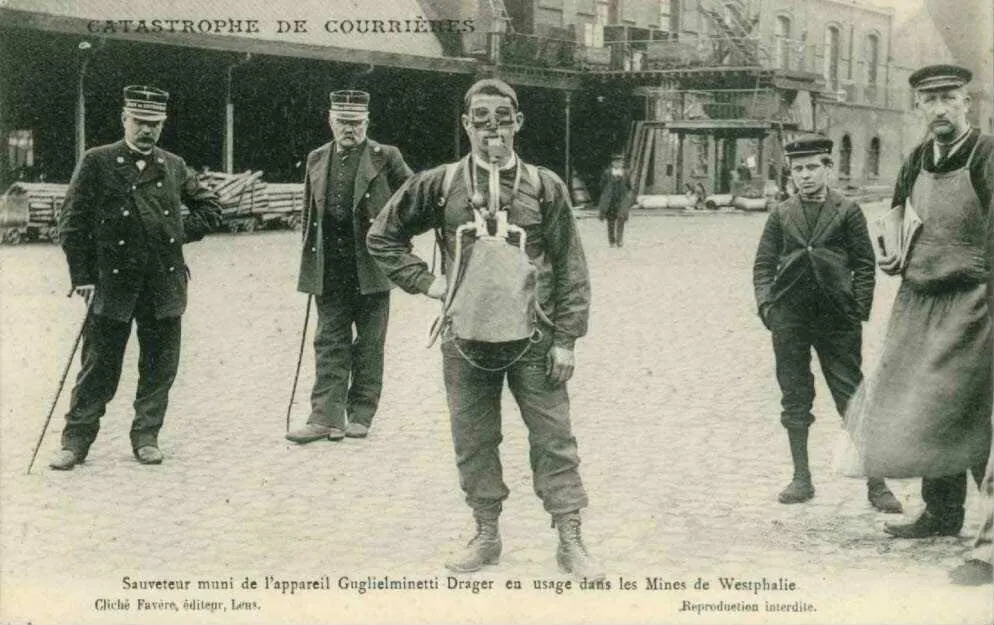

Gas rescue as a profession is little more than a hundred years old. It became possible only when engineers built breathing apparatus reliable enough to carry a person into irrespirable air and back, and it became necessary when a series of mine disasters showed what happened without it.
Timeline
| Year | Event |
|---|---|
| 1799 | Alexander von Humboldt, then a Prussian mining official, describes a respirator and safety lamps for miners. |
| 1853 | Theodor Schwann presents in Belgium a closed-circuit oxygen apparatus designed for work in mines. |
| 1878–1879 | Henry Fleuss builds and tests a practical closed-circuit oxygen apparatus in England. |
| 1880 | A Fleuss apparatus is used in work on the flooded Severn Tunnel. |
| 1902 | The first purpose-built mines rescue station in Britain opens at Tankersley, Yorkshire. |
| 1904 | Drägerwerk in Lübeck brings out its first mine rescue apparatus, the "Model 1904". |
| 1906 | The Courrières disaster in northern France: about 1,100 miners die; German rescue teams from Westphalia help with oxygen apparatus. |
| 1907 | The first Hauptstelle für das Grubenrettungswesen opens in Halle (Saale), Germany. In November the first mine rescue station in the Russian Empire starts work in Makeevka, Donbas. A central rescue post is set up in Liévin, France. |
| 1907 | Monongah, West Virginia: an explosion kills at least 362 miners, the worst mine disaster in US history. |
| 1910 | The US Bureau of Mines is established; its rescue railway cars tour the coalfields to train miners. |
| 1911 | The Coal Mines Act makes rescue stations and trained rescue teams compulsory in Britain. |
| 1912 | A joint mine rescue brigade is formed in Asturias, Spain, the origin of today's Brigada de Salvamento Minero. |
| 1922 | A decree on mine rescue and testing lays the basis of the state mine rescue service in Soviet Russia. |
| 1930s | Mine rescue units in the USSR are militarised; gas rescue stations appear at chemical and metallurgical plants. |
| 1940s–1970s | Open-circuit compressed-air SCBA spreads in fire services and industry and gradually replaces oxygen sets for short operations. |
| 1999 | The first International Mines Rescue Competition is held in Louisville, Kentucky. |
| 2001 | The International Mines Rescue Body is founded at a meeting in Poland. |
Early attempts
The dangers of mine air were known long before anybody could protect against them. Miners spoke of "damps": blackdamp that put out lamps, firedamp that exploded, and afterdamp, the poisonous mixture left by an explosion that killed more men than the blast itself. Early devices either supplied air through a hose from the surface or stored a small amount of air in a bag. They limited the wearer to a short distance from fresh air, which is exactly where help was least needed.
The decisive idea was to carry a supply of oxygen and to clean the exhaled breath chemically so that it could be breathed again. Several inventors worked on this in the nineteenth century, but their devices remained laboratory pieces.
Fleuss and Siebe Gorman
In 1878 the English engineer Henry Fleuss designed a closed-circuit apparatus: a rubber face mask, a breathing bag, a copper cylinder of compressed oxygen and a canister of absorbent that removed carbon dioxide. He tested it under water in 1879, and the next year it was used in difficult work in the flooded Severn Tunnel. Fleuss went on to work with the London firm Siebe Gorman, which developed his idea into a family of oxygen rebreathers for divers, mine rescuers and fire brigades. Its best known set, the Proto, became the standard apparatus of British mine rescue stations and was used by the London Fire Brigade until compressed-air sets were introduced in the 1960s and 1970s.
Dräger and the "Draegermen"
In Germany, Drägerwerk of Lübeck developed oxygen apparatus with a pressure-reducing valve and an injector that circulated the breathing gas. Its Model 1904 was among the first long-duration sets made specifically for mine rescue, and it was soon improved together with working rescue teams. When the Courrières mine exploded in March 1906, rescue corps from Westphalian collieries travelled to France with such apparatus. Their arrival was widely noticed, including in the British Parliament, and it helped convince mining countries that rescue needed trained teams, not only brave volunteers.
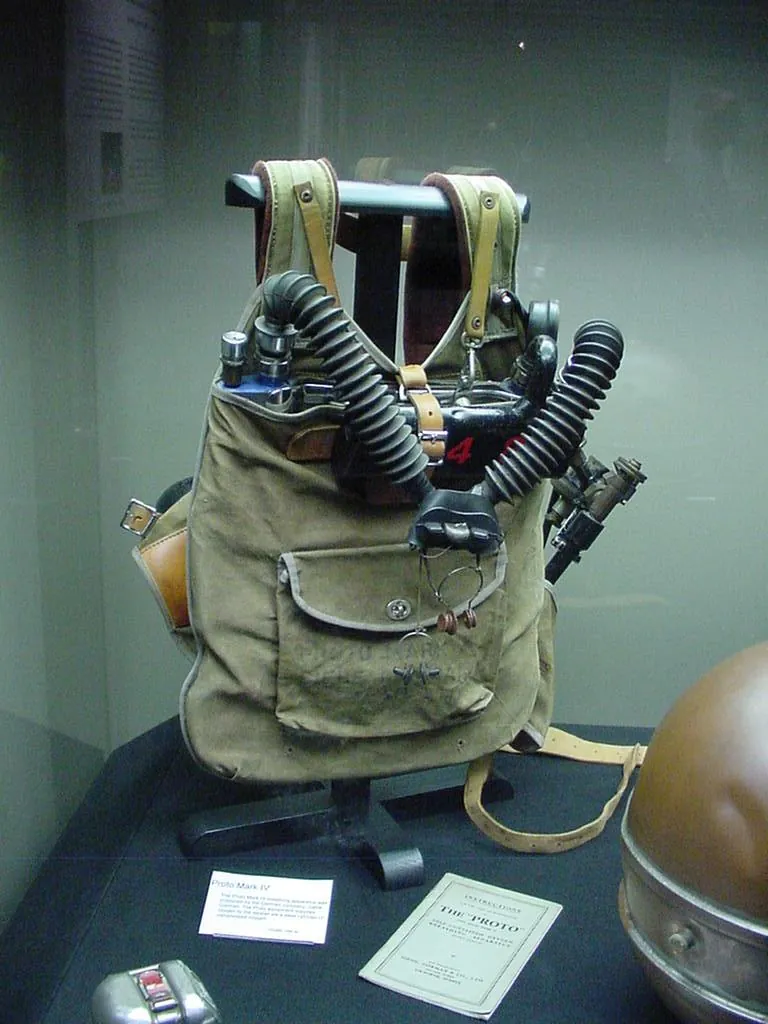

In North America, mine rescuers equipped with these sets became known as "Draegermen". The word is still used for mine rescue team members in the United States and Canada, long after the apparatus has changed.
Disasters that built the rescue services
Each country's rescue system was shaped by its own catastrophes.
- France. After Courrières, the coal owners' central committee opened an experimental station and a central rescue post at Liévin in 1907. The Liévin site later passed to the coal industry research centre and, in 1990, to today's national institute for industrial environment and risks (INERIS).
- Germany. Regional Hauptstellen für das Grubenrettungswesen were set up from 1907 to train mine rescue brigades (Grubenwehren), test apparatus and coordinate rescue. Their successor today also serves the chemical industry's gas protection teams.
- United States. A run of explosions in 1907, Monongah above all, led Congress to create the Bureau of Mines in 1910. Its rescue cars, refitted railway carriages with apparatus and instructors, travelled from coalfield to coalfield.
- United Kingdom. Tankersley opened in 1902 as a private initiative. The Coal Mines Act 1911 required owners to provide rescue stations within reach of every large mine, with trained teams and maintained apparatus.
- Russia. After an explosion at a mine in Yuzovka in 1907, the mine owners of southern Russia decided to create rescue stations; the first began work in Makeevka in November 1907, with about ten staff and imported apparatus. On 6 July 1922 a decree on mine rescue and testing laid the foundation of the state mine rescue service, which is today part of the Ministry of Emergency Situations.
From mines to industry
The same knowledge soon moved above ground. Coke ovens, blast furnaces, gasworks and chemical plants produced carbon monoxide, chlorine, ammonia and hydrogen sulfide in quantity, and accidents in vessels and pipe trenches looked very much like those in mines. In the Soviet Union, gas rescue stations were created at large plants in the 1930s; the service at the Chernorechensky chemical works in Dzerzhinsk, for example, dates its foundation to 1936. Gas rescue services of this kind still protect chemical, oil and gas and metallurgical sites in Russia and neighbouring countries. Elsewhere, similar work is done by works fire brigades, industrial emergency response teams and gas protection teams.
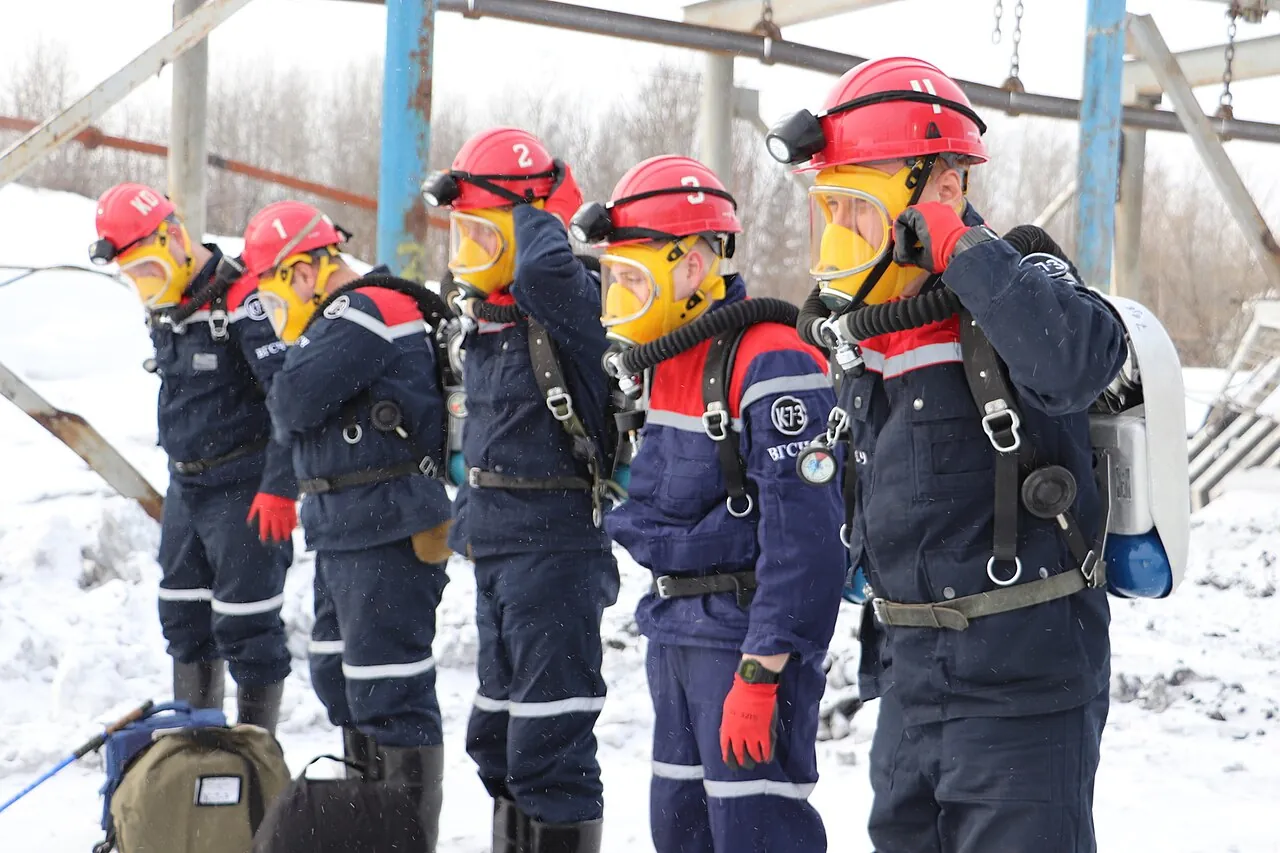

From oxygen to compressed air
Oxygen rebreathers were light for their duration but complex to maintain and demanding to use. After the Second World War, open-circuit apparatus that simply supplied compressed air from a cylinder through a demand valve became practical. It was easier to train for and to service, and it suited the short, intense operations of fire services. Through the 1950s to the 1970s compressed-air SCBA became the standard in fire brigades and most industrial teams. Closed-circuit apparatus kept its place where long duration matters: in mine rescue, tunnels and long underground routes.
The modern era
Since the 1980s the apparatus has changed in many small steps rather than one big one:
- Positive pressure in the face mask became the norm, so that any leak goes outward.
- Composite cylinders wrapped in carbon fibre made 300-bar air supplies light enough for longer work.
- Electronics added pressure displays, remaining-time calculations, motion sensors and distress alarms.
- Telemetry lets the entry control point see each wearer's pressure and alarms by radio.
- Thermal imaging cameras allow teams to search smoke-filled spaces much faster.
- Standards at national, European and international level now set test methods and performance requirements; see Standards.
Sources
- Archives départementales du Pas-de-Calais: the Courrières disaster
- UK Parliament, Hansard 1906: life-saving apparatus in mines
- MRS Training & Rescue: heritage of the UK mines rescue service
- Coal Mines Act 1911 (legislation.gov.uk)
- London Fire Brigade Museum: a brief history of breathing apparatus
- BG RCI: emergency management department (Hauptstelle für das Grubenrettungswesen, 1907)
- International Mines Rescue Body