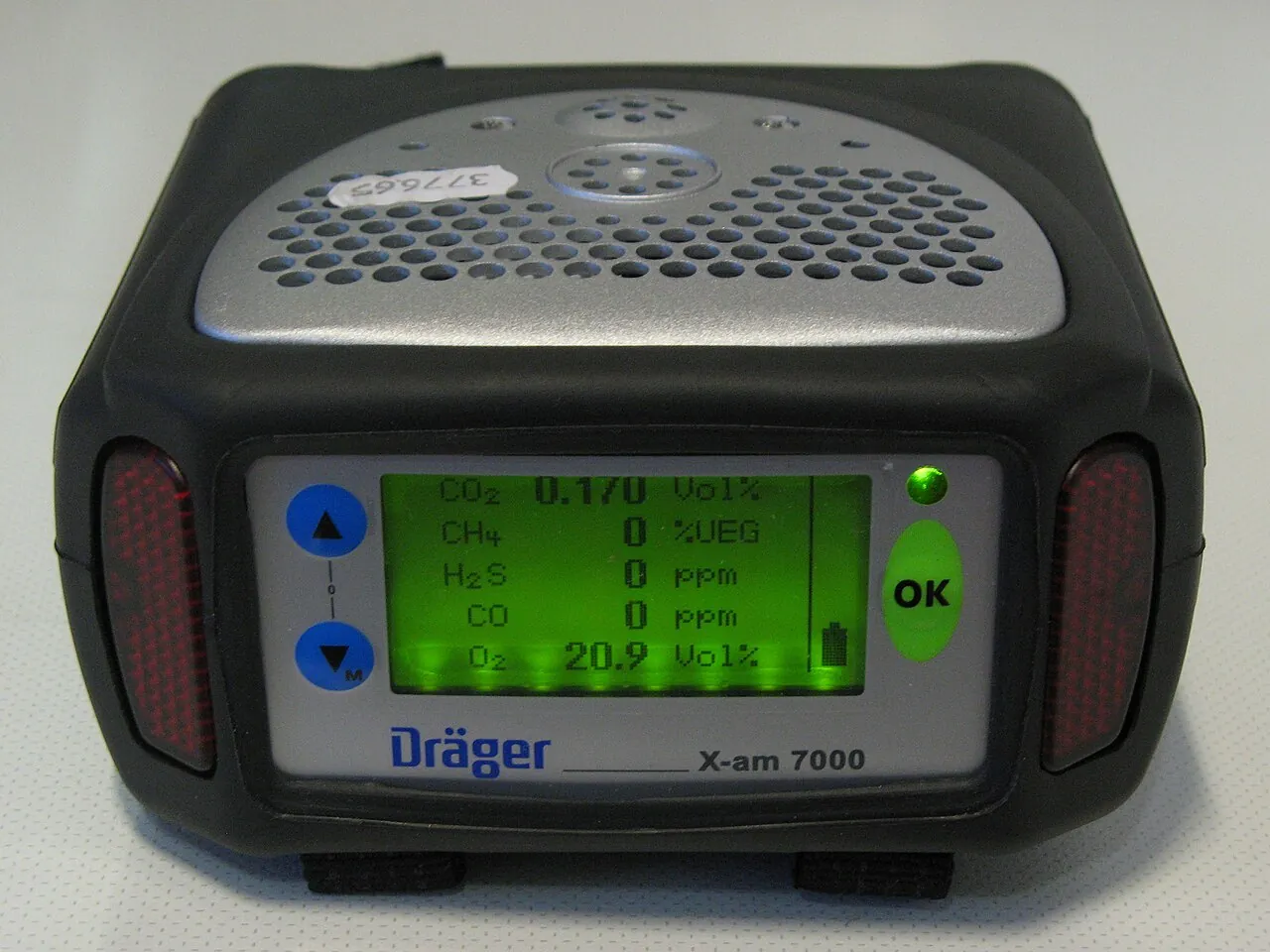

A portable gas detector is the instrument on which every entry decision in a hazardous atmosphere rests. Choosing one is less about the brand than about matching sensors, sampling method and alarms to the gases and the work you actually face — and about being able to keep the instrument in working order for years.
Start from the hazards, not the catalogue
Before looking at any instrument, list what can be present where your people work: oxygen deficiency or enrichment, flammable gases and vapours, specific toxic gases. Look at the processes, the substances stored and transported, the products of decomposition (sewage, silage, sludge) and of combustion. A risk assessment of the tasks — routine maintenance entries, emergency response, rescue — tells you which gases must be measured and at which concentrations alarms must sound. The page on hazardous gases gives an overview of the most common ones.
Single-gas or multi-gas
Single-gas detectors are small, inexpensive and simple. They are worn as personal monitors where one gas is the known hazard — hydrogen sulfide in oil and gas production, carbon monoxide near combustion processes — or where oxygen deficiency is the main concern, for example near nitrogen or argon systems.
Multi-gas detectors measure several gases at once. The most widespread combination is the "four-gas" instrument: oxygen, flammable gases (% LEL), carbon monoxide and hydrogen sulfide. It covers the typical hazards of tanks, sewers, wells and pits. Many instruments accept a fifth or sixth sensor for gases such as sulfur dioxide, ammonia, chlorine or nitrogen dioxide, or a photoionisation detector for organic vapours.
For entry into confined spaces and for rescue teams, a multi-gas instrument is the usual choice, because the hazard is rarely limited to one gas and conditions can change.
Sensor types
| Sensor | Measures | Strengths | Limitations |
|---|---|---|---|
| Electrochemical | Oxygen, CO, H₂S and many other toxic gases | Low power, selective, ppm resolution | Limited life (often 1–3 years), cross-sensitivities, affected by extreme temperature and humidity |
| Catalytic bead (pellistor) | Flammable gases and vapours, % LEL | Responds to most flammable gases, proven | Needs oxygen to work, can be poisoned by silicones, lead compounds, sulfur compounds |
| Infrared (NDIR) | Hydrocarbons, carbon dioxide | Not poisoned, works in inert atmospheres, long life | Does not detect hydrogen; response differs between hydrocarbons |
| Photoionisation (PID) | Many organic vapours at low ppm | Very sensitive | Not selective; lamp and cleaning maintenance |
The choice between catalytic and infrared sensors for flammable gases matters. A catalytic sensor reads low or not at all where oxygen is lacking, and silicone vapours can damage it without warning. An infrared sensor avoids both problems but cannot see hydrogen. Where hydrogen may be present, a catalytic or a dedicated hydrogen sensor is needed.
Pumped or diffusion sampling
A diffusion instrument lets gas reach the sensors by itself; it is small and suitable as a personal monitor worn in the breathing zone. To test a confined space before entry, however, the atmosphere must be sampled from outside, at several depths, through a hose and probe. That requires a pump, either built in or as a clip-on module.
When sampling through a hose, allow time for the gas to travel the length of the hose and for the sensors to respond — manufacturers state the time per metre of hose. Check the pump and hose for leaks before use; a leak dilutes the sample with fresh air and gives a falsely reassuring reading.
Alarms and display
Alarms must be noticed in the real conditions of work: noise, protective clothing, poor light. Look for a loud audible alarm, bright visual alarms visible from several angles and a vibrating alarm. Toxic gas channels usually have two instantaneous alarm levels and alarms for time-weighted average (TWA) and short-term exposure (STEL); oxygen needs both a low and a high alarm. Alarm set points should follow your national limits and your own procedures, not only the factory settings.
A clear display, readable with gloves and a mask, simple buttons and a visible indication that the instrument is working ("heartbeat" signal) reduce mistakes.
Explosion protection and standards
A detector used where a flammable atmosphere may occur must itself be explosion-protected. In the European Union it must comply with the ATEX equipment directive and be marked for the zones in which it is used; internationally the IECEx scheme certifies equipment to IEC standards. Check that the marking matches the gas groups and temperature class of your sites — and, for mines, Group I.
Performance — how accurately and how quickly the instrument measures — is covered by separate standards. In Europe these have long been EN 60079-29-1 for flammable gases, EN 50104 for oxygen and the EN 45544 series for toxic gases. In November 2025 the IEC published IEC 60079-29-0, which brings general requirements for flammable, oxygen and toxic gas detectors into one standard and replaces IEC 60079-29-1. European adoption and transition periods are still running, so ask suppliers which edition the instrument has been tested to. See also standards.
Data logging and fleet management
Most modern instruments record readings, alarms and test results. Logs help to investigate incidents, to show that bump tests and calibrations were done, and to see how workers were exposed. Docking stations can bump-test, calibrate, charge and download several instruments automatically, which saves time in large fleets.
Cost of ownership
The purchase price is only part of the cost. Over the life of an instrument you pay for replacement sensors, calibration and test gas, docking stations or service contracts, batteries, filters and repairs. Compare the expected sensor life, the warranty and the availability of service and spare parts in your country. A cheaper instrument that cannot be serviced locally may spend weeks out of use.
Training
Everybody who carries a detector should know how to switch it on and let it complete its self-test, how to perform a bump test, what each alarm means and what to do when it sounds, how to sample through a hose, and what the instrument cannot detect. Include the detector in drills, so that people react to alarms automatically. More on maintenance on the page maintenance and on equipment in general under equipment.
Sources
- IEC: IEC 60079-29-0:2025 — gas detection equipment, general requirements and test methods
- European Commission: Equipment for potentially explosive atmospheres (ATEX)
- IECEx — IEC System for Certification to Standards relating to Equipment for use in Explosive Atmospheres
- OSHA: Calibrating and Testing Direct-Reading Monitors (SHIB)