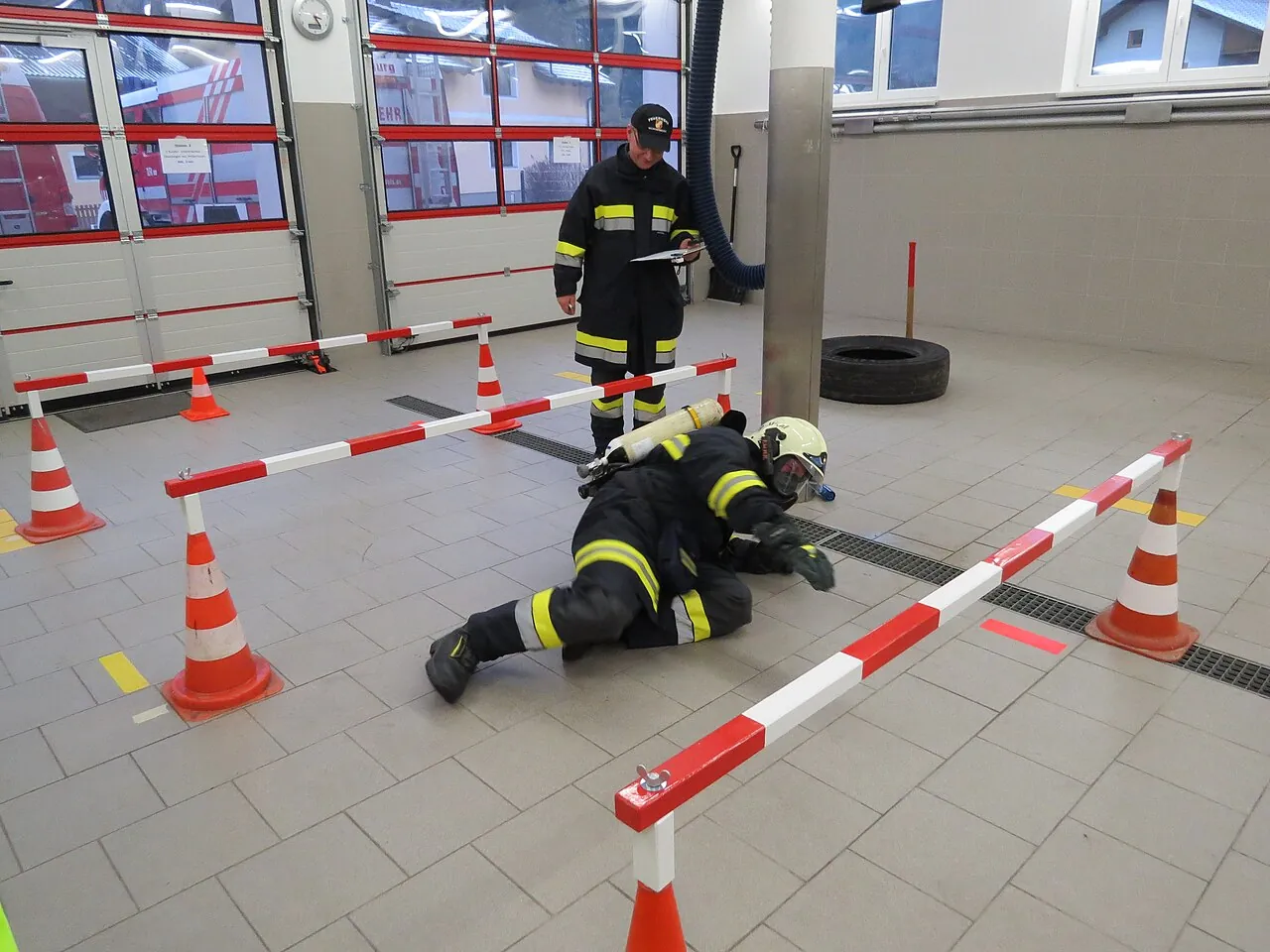

A rescuer is only as good as the last drill. Countries organise their rescue services in very different ways, but the training follows the same pattern everywhere: careful selection, a basic course, practice under realistic load, and regular drills for as long as the rescuer stays in service.
Selection and medical fitness
Work in breathing apparatus is heavy physical work in heat, often in protective clothing, with a high heart rate and limited vision. Candidates are therefore examined before they start and at regular intervals afterwards. The examination usually covers the heart and lungs, blood pressure, vision and hearing, and the ability to wear a tight-fitting face mask. Many services add a physical test, such as a timed walk or climb carrying a load, and a psychological assessment. Fitness is not a one-off qualification: a rescuer who fails a periodic examination stops wearing apparatus until cleared again.
Initial training
The basic course combines theory and practice:
- properties of gases and vapours, oxygen deficiency, explosion limits;
- gas detectors, measurement strategy and interpretation of readings;
- design, checks and use of the team's breathing apparatus;
- team procedures, signals, entry control and standby;
- first aid and carrying a casualty out of a confined space;
- rope work, ladders and confined-space access;
- the specific hazards of the sites the team protects.
The new member then joins a team and works under supervision before being counted as a full member.
Training galleries and heat-and-smoke chambers
Most services have a training facility where wearers work under controlled stress. In mining this is a training gallery: a mock-up of underground roadways, sometimes with smoke, heat and humidity, where teams practise exploration, rescue and building seals. Fire and industrial services use breathing apparatus courses with crawl spaces, ladders, treadmills or step machines and smoke generators. The aim is the same: to let wearers learn their own air consumption and limits, and to practise the team routine until it is automatic.
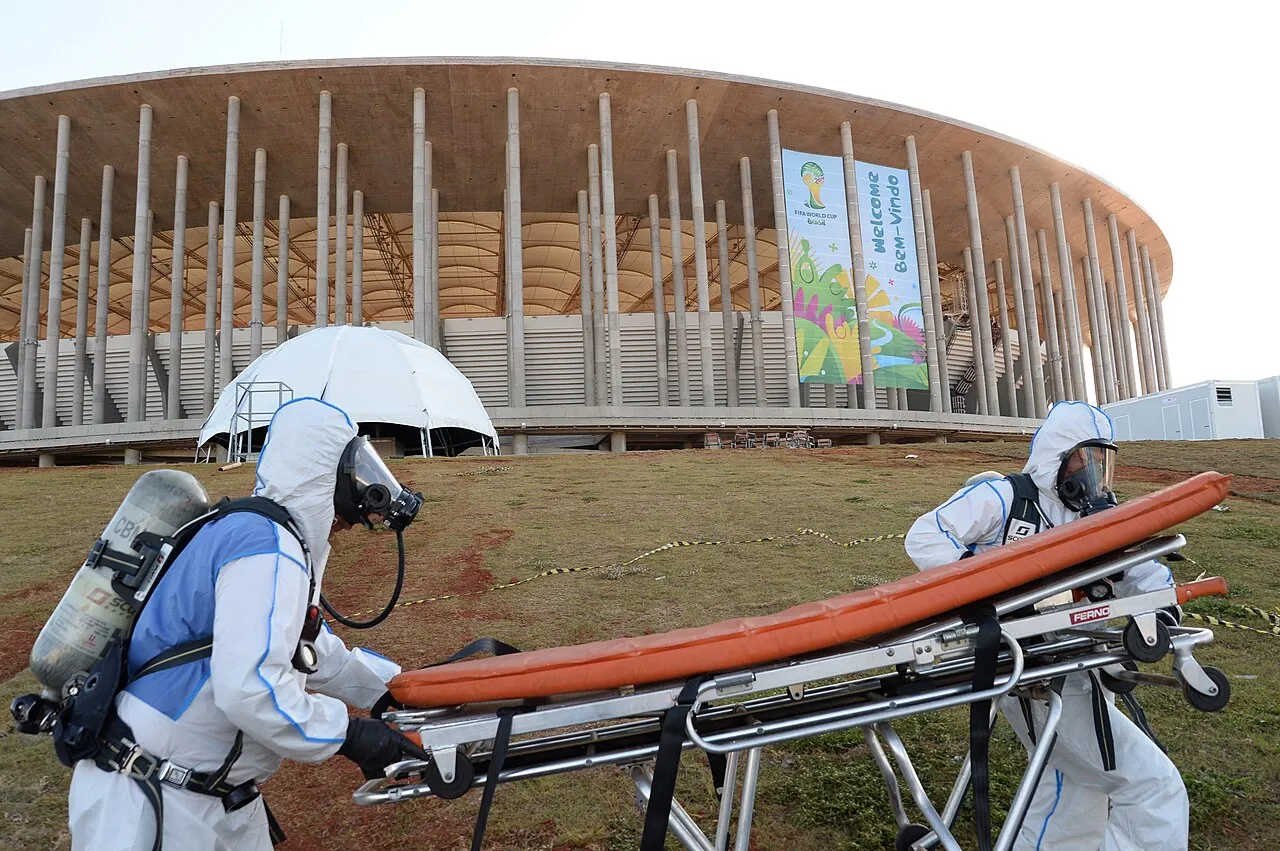

Regular drills
After the basic course, training never stops. Typical elements are:
- monthly or bimonthly practice wearing apparatus for a set time;
- at least one exercise a year under heavy load or in heat and smoke;
- exercises at the actual facilities the team protects, with the operating staff;
- refresher theory on new equipment, procedures and lessons from incidents;
- full-scale exercises with several teams and an incident command.
Competitions
Rescue competitions are a long tradition, especially in mining. Teams solve a simulated emergency against the clock under judges, then take written and practical tests: first aid, gas detection, apparatus checks and repair. Competitions are not just sport; they show teams and their employers where procedures break down. National contests are held in many mining countries, and the International Mines Rescue Competition brings teams together every two years; see Organisations.
Examples from different countries
United States
Mine rescue teams for underground mines are regulated by the Mine Safety and Health Administration (MSHA) under 30 CFR Part 49. Each member first completes an initial course of at least 20 hours on the team's breathing apparatus. For underground coal mines, refresher training is at least 96 hours a year, given in blocks of at least 8 hours every two months; it includes participation in local mine rescue contests, underground sessions at least every six months, wearing the apparatus under oxygen for at least two hours every two months, and work in smoke or simulated smoke once a year. For metal and non-metal mines the refresher minimum is 40 hours a year. Fire services and industrial teams follow OSHA rules on respiratory protection and NFPA standards on training and fitness.
United Kingdom
Mine rescue started with colliery teams and rescue stations required by the Coal Mines Act 1911. Today the service is provided by MRS Training & Rescue, which combines full-time rescue staff with training centres around the country and also serves tunnelling, confined-space and other industries. In the fire and rescue services, breathing apparatus wearers train in purpose-built hot-fire and smoke facilities.
Germany
Mine rescue brigades (Grubenwehren) at mining companies and gas protection teams (Gasschutzwehren) in the chemical industry are trained with the support of the Hauptstellen für das Grubenrettungswesen, today part of the BG RCI accident insurance institution. In fire brigades, training of breathing apparatus wearers (Atemschutzgeräteträger) follows the fire service regulation FwDV 7: a basic course, at least one exercise a year in a breathing apparatus training facility (Atemschutzübungsanlage) and one operational exercise under breathing protection. Medical fitness is assessed by an occupational physician; the former DGUV principle G 26 was replaced in 2022 by the DGUV recommendations for occupational medical examinations.
France
Coal mining ended in 2004, but the mine rescue tradition born after Courrières lives on in the expertise of national institutes. Firefighters (sapeurs-pompiers) are trained in the use of self-contained breathing apparatus (ARI) as part of their basic training, with regular maintenance of skills. For confined-space work in water and sewer networks, the INRS runs the CATEC scheme, which certifies workers and supervisors after a practical examination on a safe training installation.
Spain
The Hunosa mining rescue brigade in Asturias, formed in 1912, is one of Europe's oldest. With the decline of coal mining it has become a small specialist team that also trains others in confined spaces, explosive atmospheres and fire fighting, and takes part in rescues in tunnels, caves and wells.
Poland
The Central Mine Rescue Station (CSRG) in Bytom, with origins in 1908, coordinates mine rescue in Polish mines, keeps professional rescue teams on standby, trains members of mine rescue teams and runs training facilities, including simulators.
Russia
Mine rescue in Russia is provided by the paramilitary mine rescue units (ВГСЧ) of the Ministry of Emergency Situations, with branches in the main mining regions. Industrial sites are covered by professional gas rescue units. Under the Government regulation on attestation of rescue services and rescuers (No. 1091 of 2011), a person becomes a rescuer only after professional training, a medical examination and a psychiatric evaluation, followed by initial attestation; periodic attestation follows every three years. A national professional standard describes the work of gas rescue specialists at chemical and explosion-hazardous sites. Teams take part in regular competitions of professional skill.
Australia
State mine rescue organisations, such as Mines Rescue in New South Wales and the Queensland Mines Rescue Service, train mine site volunteers together with full-time staff, and annual regional and state competitions are an important part of the system.