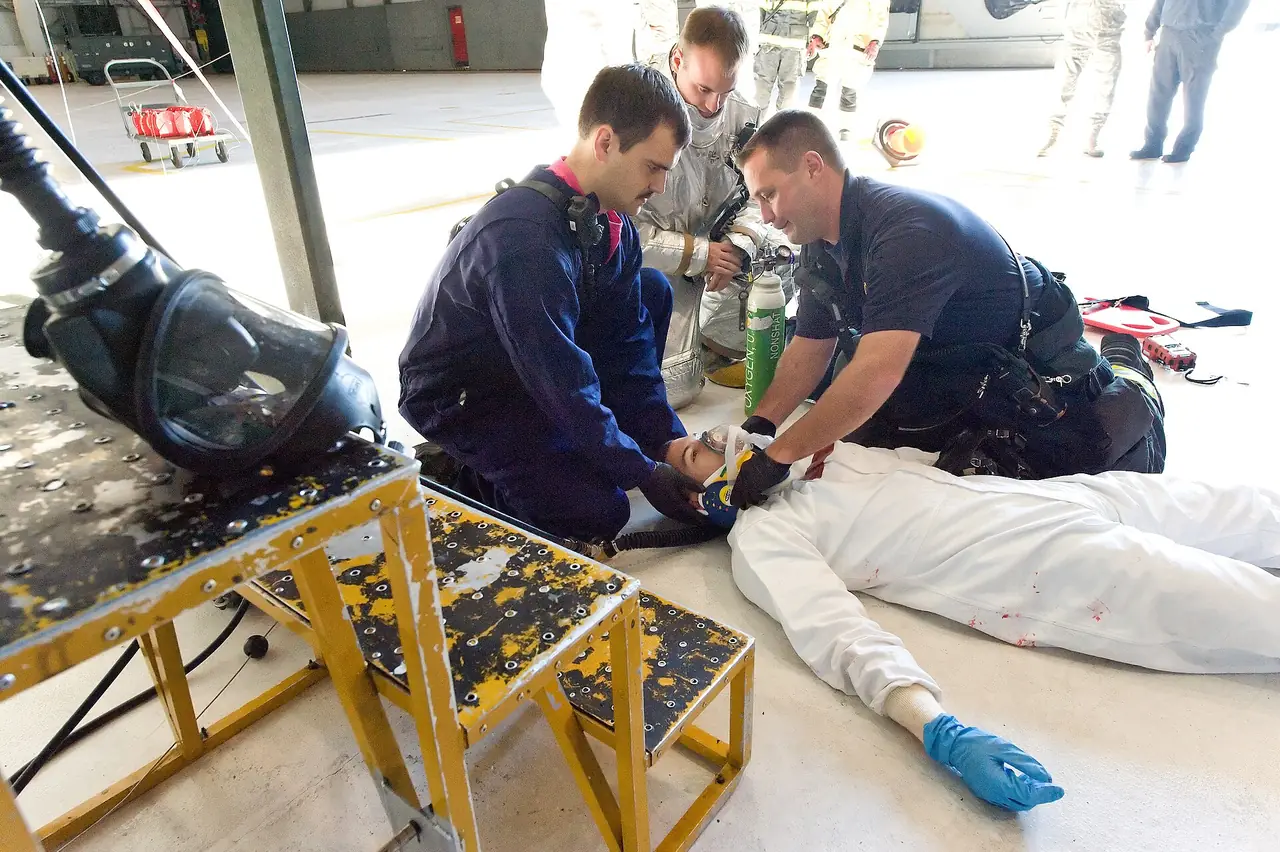

Air with too little oxygen has no smell, no colour and causes no pain or breathlessness that would warn the victim. A worker who leans into a nitrogen-filled vessel can lose consciousness within a breath or two, and the colleague who climbs in to help often becomes the second victim. Only an instrument can tell you that the oxygen is gone.
Where oxygen goes
Normal air contains about 20.9 % oxygen by volume. The level falls when another gas displaces air or when oxygen is consumed.
- Nitrogen is used in huge quantities to purge and blanket tanks, reactors and pipelines, to protect products from oxidation and as liquid nitrogen for cooling and freezing. Leaks from cryogenic liquid are especially dangerous: one litre of liquid nitrogen produces several hundred litres of gas.
- Argon and helium are used in welding, metallurgy and laboratories. Argon is heavier than air and collects in pits, tanks and the bottom of vessels.
- Carbon dioxide is produced by fermentation (wine cellars, breweries, silos, manure pits), used in fire-suppression systems and dry ice, and released from some rocks and soils. Besides displacing oxygen, it is toxic in its own right at high concentrations.
- Consumption of oxygen occurs through rusting of steel inside closed tanks and ships' holds, through decay of organic matter, through combustion and through the oxidation of coal, grain, wood chips and other bulk materials.
What happens to the body
The US Chemical Safety Board, in its safety bulletin on nitrogen asphyxiation, reproduces the following table of effects (source: Compressed Gas Association):
| Oxygen, % by volume | Possible effects |
|---|---|
| 20.9 | Normal |
| 19.0 | Some unnoticeable adverse physiological effects |
| 16.0 | Faster pulse and breathing, impaired thinking and attention, reduced coordination |
| 14.0 | Abnormal fatigue on exertion, emotional upset, faulty coordination, poor judgement |
| 12.5 | Very poor judgement and coordination, impaired breathing, nausea and vomiting |
| below 10 | Inability to move, loss of consciousness, convulsions, death |
The body senses rising carbon dioxide, not falling oxygen. In an atmosphere of nitrogen or argon, the victim breathes out carbon dioxide normally and feels no shortness of breath. Judgement fails before anything feels wrong, so people do not recognise the danger even when they begin to feel strange. According to the CSB, breathing a strongly oxygen-deficient atmosphere can cause unconsciousness after only one or two breaths, and an atmosphere with 4–6 % oxygen causes coma in less than 40 seconds. Without oxygen, survival is a matter of minutes.
Why rescuers die
The CSB identified 85 nitrogen asphyxiation incidents in US workplaces between 1992 and 2002, with 80 people killed and 50 injured; more than 60 % of the victims were working in or next to a confined space, and about 10 % of the deaths were people attempting a rescue. A NIOSH alert on confined spaces found that more than 60 % of confined-space fatalities occurred among would-be rescuers.
The reasons repeat from incident to incident: the victim is visible and close, the atmosphere looks normal, the instinct to help is strong and there is no time to think. A rescuer without breathing apparatus who goes in is exposed to exactly the same atmosphere. The answer is preparation: a standby who does not enter, retrieval equipment rigged before entry, isolating breathing apparatus on hand, and drills in which people practise not rushing in. See confined-space entry.
Purging and inerting
Inerting is often necessary to prevent fire and explosion — but it turns a flammable hazard into an asphyxiation hazard. Good practice includes:
- marking every inerted vessel and every nitrogen connection clearly, with warning signs at manways;
- replacing the inert gas with air and confirming oxygen readings at several levels before entry;
- keeping breathing-air supply systems physically separated from nitrogen lines, with connectors that cannot be interchanged (the CSB bulletin describes workers who connected their breathing-air respirators to a nitrogen line);
- providing fixed oxygen monitors with alarms in rooms where nitrogen, argon or CO₂ is stored or used, and ventilating such rooms;
- treating the area around open manways and vents of inerted vessels as hazardous — gas flows out and collects in low places.
Oxygen monitoring
Every person entering a confined space or working near inert gas systems should wear a detector with an oxygen sensor, set with a low and a high alarm. The oxygen reading is the first one taken in pre-entry testing, because it also affects the response of catalytic flammable-gas sensors. A drop of even 0.5–1 % from 20.9 % is a sign that another gas is present: if nitrogen has reduced oxygen to 19.9 %, roughly 5 % of the air has been displaced, and that gas may itself be toxic. See choosing a portable gas detector.
Limits in different countries
| Country / source | What the value means |
|---|---|
| USA, OSHA 29 CFR 1910.146 | Below 19.5 % is oxygen-deficient, above 23.5 % oxygen-enriched |
| France, INRS | Recommended range 19–21 %; below 19 % already indicates an anomaly |
| Germany, DGUV Regel 112-190 | Filtering respirators require at least 17 % oxygen |
| Russia, order No. 902n | Entry without breathing apparatus only with at least 20 % oxygen; alarm thresholds not below 19 % and not above 23 % |
The figures are not directly comparable: some are entry criteria, some alarm settings, some limits for filtering respirators. What they share is that any reading noticeably below normal must be explained before anyone goes in.